
The Marangu route is sometimes called the Coca-Cola Route becaue it is relatively easy due to the gentle slopes. It is the oldest and most popular route. It is referred to as the tourist route or beginner route due to the services such as sleeping huts (Dormitory style), along the way to the summit. It may be considered easier, but the success rate is usually lower, around 27-50% for a 5-day trek. This is attributed to fewer days that limits time to adjust to the altitude. On a 6-day trek, the success rate is 60-80% rate. The more you train for hiking 5-7 miles uphill in higher altitudes, add days, and use high-quality gear, will greatly benefit your experience. Experienced guides will help you along the way to reach the summit. After all, they do it regularly. This is the shortest route, and the ascent and descent is along the same path. The Marangu route covers approximately 45mi (72km) long, and covers 13,435ft (4,095m) in elevation gain. The Marangu Gate is around 6,100–6,135 ft, and Uhuru Peak is 19,341 ft. The elevation gain is about 13,200–13,240 ft.
5-Day Route
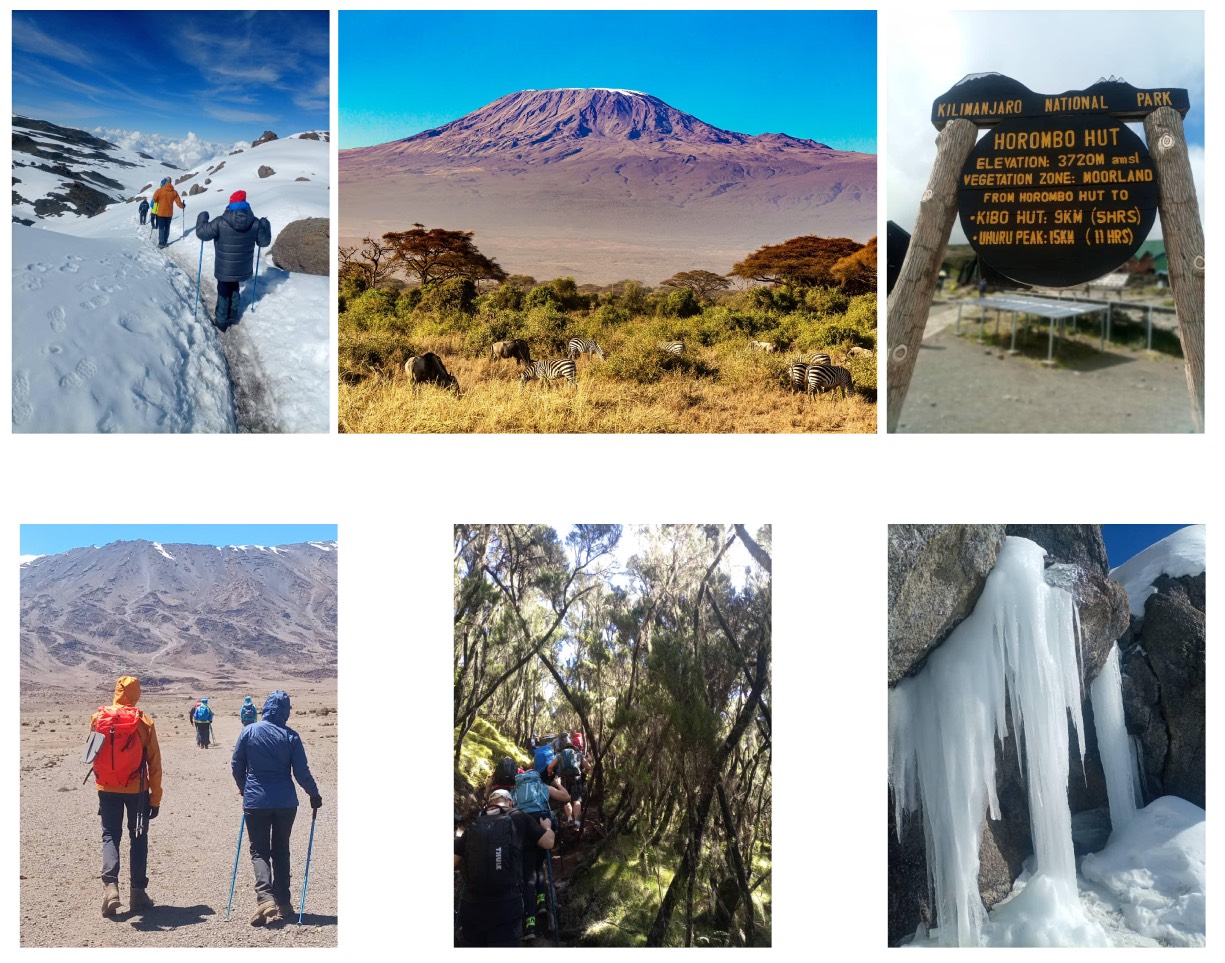
(6 Total Nights with Hotel Stay)
Arrival and Pre-Climb Briefing Day
Today has no planned activities, except to arrive at your lodge in time for a pre-climb briefing with your mountain guide.
Day 1: Moshi Town to Marangu Gate to Mandara Hut
You will be transferred by road from Moshi at 9:00am, to Manrangu
Gate (1-2 hours). After registration, you will trek in the rain forest zone with your guide. You may encounter some wild animals such as: the Colobus and Blue monkey, sunbirds, flycatchers, barbets, and woodpeckers, on your way to the Mandara hut. After a rest, you will trek to the rim of Maundi Crater with a spectacular view of Mawenzi Peak. A little later, you will descend back to the Mandara hut.
Elevation: 6100ft (1860m) to 9105ft (2775m)
Hiking Time: 3-5 hours
Distance: 4.5mi (7km)
Habitat: Rain Forest, humid
Suggestions: Sun-protection, insect repellent, moisture-wicking short or long base-layer
Day 2: Mandara Hut to Horombo Hut
Today’s trek is a little longer. It will take you outside of the rainforest, and into a heather and moorland zone. This will feel more like a mountain trek with the peaks of Kibo and Mawenzi towering in the background. You may still encounter some birds along the trail, and come across the giant Kilimanjaro groundsels that are unique to the park.
Elevation: 9105ft (2775m) to 1214ft (3700m)
Hiking Time: 5-6 hours
Distance: 7mi (11km)
Habitat: Rain Forest to Heath and Moorland Zone
Suggestions: Clothing layers from humid to cooler, sun protection
Day 3: Horombo Hut to Kibo Hut
Your hike today takes you directly towards the Kibo cone, while steadily climbing through the alpine desert. The landscape will be changing dramatically as you leave the heather and moorland zone. You will journey on to the Barren Saddle (The dip between the Kibo and Mawenzi peaks). You will reach the hut in time to rest for your summit climb tonight.
Elevation: 1214ft (3700m) to 15430ft (4703m)
Hiking Time: 5-7 hours
Distance: 7.5mi (12km)
Habitat: Vegetation-less plateau
Suggestions and conditions: The last water point to collect for the trek, electrolytes, temperature swings, dry, wet wipes, extra layers
Day 4: Kibo Hut to Gilman’s Point to Uhuru Peak to Horombo Hut
In the early morning (Around midnight), you will begin your final ascent to the summit of Uhuru peak through the arctic zone. This trek is a steep hike over loose volcanic scree through the dark and cold night. We will walk a slow pace in a zig-zag pattern towards Gilman’s Point (5681m or 18640ft), which is your first stop on the Kibo Crater Rim. From here, a short but difficult hike remains to take you past Stella Point (The first stop on the rim for those summiting from Barafu Camp/Southern Circuit). Then, continuing on to Uhuru Peak (5895m or 19341 ft.), the highest point on the continent of Africa. You will not spend long on the peak due to the extreme altitude, and will descend back down to the base camp for your breakfast/brunch. After your gear is packed up, you will continue the descent back through the alpine desert, heather and moorland, where you will stop for the night.
Elevation: 15,430ft (4703m) to 19,341ft (5895m)
Hiking Time:14-18 hours
Distance: 13mi (21km)
Habitat: steep, loose rocks and volcanic scree
Suggestions and conditions: extreme cold weather gear, hydration, trekking poles, first aid, sun protection and snacks
Day 5: Horombo Hut to Marangu Gate to Moshi Town
Your final day on Kilimanjaro is a descent through the southeastern
Rainforest Zone until you reach the Marangu Gate. Here, our vehicle will be waiting to take you back to Moshi Town, and your lodging. Usually, the crew will leave you at the Marangu Gate, and it is a perfect opportunity to give them a tip as a token of your appreciation. A Certificate of Achievment will be handed out to you at this time.
Approx. driving distance: 1 hour
Elevation: 12,220ft (3700m) to 6,100ft (1860m)
Hiking Time:5-7 hours
Distance: 10.5mi (17km)
Habitat: Montane Rainforest-moorland through the heath and moorland zone, and finally into the tropical rainforest
Suggestions and conditions: layers of clothing, rain gear, sun protection, cash for guide and porters
6-Day Marangu Route (7 Nights) Arrival Day
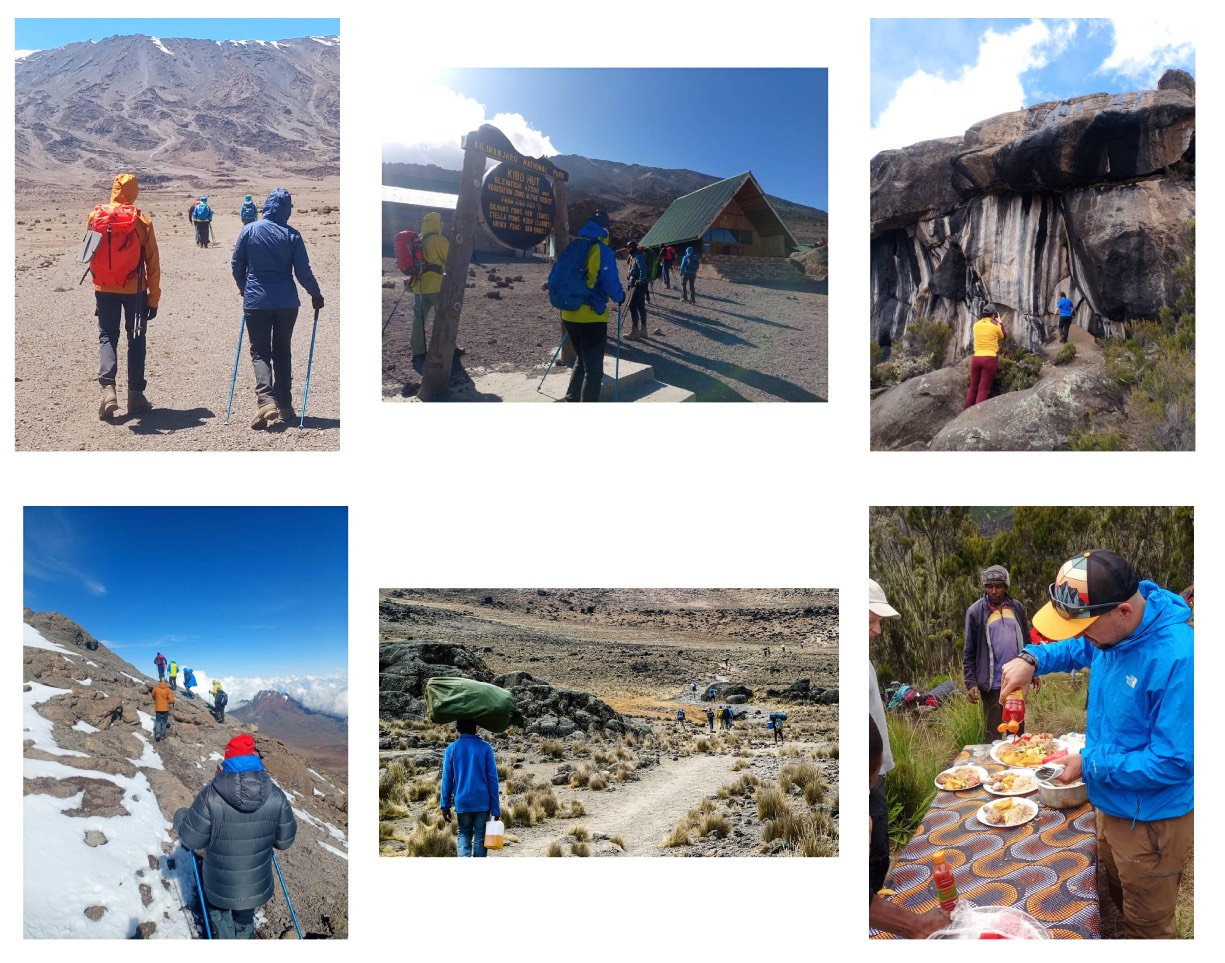
Our representative will pick you up at the airport and transfer you to Moshi for the overnight preparation of climbing the following day.
Day 1: Leave Moshi town about 9:00am, and drive for about 45
minutes to the Marangu Gate on the eastern side of Kilimanjaro.
You will do the necessary paperwork at the park gate with registration. You will begin hiking around 10:30am, and hike through the rainforest from the park gate (6000 ft.) to Mandara Hut (9000ft.), taking about 4 hours. We stop halfway for lunch, and reach Mandara Huts at about 2:00-3:00pm. Unpack, rest and
have some tea or coffee. Dinner is served during the early evening about 7:00pm. A side trip to Maundi Crater (about 15 minutes away) is a good way to see the surroundings, as well as views of Kenya and Northern Tanzania. Bathrooms are available with running water.
Day 2: Wake to breakfast (Approx. 7:30am) and pack for the
next leg. Break camp at about 8:30am., and hike to Horombo Huts (12,000 ft.) This leg should take about 5-6 hours. You travel through lower heather land, with small shrubs being the main vegitation. Stop halfway through for lunch. The views of Mawenzi are amazing. The summit of Kibo can be seen from Horombo Huts. You arrive at the Horombo Huts at about 3: 00pm, rest and unpack, and prepare for dinner. Bathrooms are available with running water.
Day 3: Stay at Horombo Huts (12,000 ft.) for acclimatization. It will be a training day, and you will walk around the Mawenzi area to get familiar with the summit weather.
Day 4: Wake to breakfast as usual (If you wake before sunup, you can get some great photos of the sunrise). Pack and begin the hike to Kibo Huts (15,500 ft.). The first half of the day’s hike traverses the upper heath land, while the second half crosses the vast saddle that connects Mawenzi and Kibo. The saddle is an alpine desert that resembles a lunar landscape. Be careful to notice signs of altitude sickness. The day’s hike should take 6 to 7 hours, stopping halfway to lunch. No running water at the Kibo Huts.
Day 5: Wake around midnight to a light breakfast, and then prepare for the summit ascent. This part of the hike is carried out during the early morning before dawn so that the climbers reach Uhuru Peak around sunrise. This part is the most mentally and physically challenging portion, and we will be hiking in the dark for several hours. Leave at 1:00am., and reach Gilman’s Point around 7:00am. The climbers are met with views of the crater from Gilman’s Point because it is on the Crater Rim. Another 2 hours of hiking brings the climber to Uhuru Peak (19,340 ft.) at about 8:30am. From there, you will descend back to Kibo Huts, collect your things and cross the saddle again at Horombo Huts where you will spend the night. You will eat dinner and get some well-deserved sleep.
Day 6: Wake as usual, pac, and descend to Mandara Huts. Take lunch there and continue to the park gate where you will be met by your transport back to Moshi. You should reach the park gate around 2:00 or 3:00pm.You now drive back to Moshi for a long overdue hot shower, overnight in hotel in Moshi Town. It is recommended and tips are highly appreciated at the end of their trip. Tips can be given to the Guide at the hotel in Moshi/Arusha. This is also where successful climbers receive their summit certificates. Those climbers who reached Stella Point (5685m) are issued with green certificates and those who reached Uhuru Peak (58956m) receive gold certificates.